

Mission Updates
Presenting the Marvel Champions Rules Reference Update 1.8
Greetings, heroes!
The Marvel Champions: The Card Game rules team is pleased to present to you with version 1.8 of our online Rules Reference. This update is intended to add new rules introduced to the game since our last update, address some areas of the rules that were not addressed previously, and add clarity in some areas that were previously unclear. All of these updates are intended to make your games of Marvel Champions play as smoothly as possible!
Today, we would like to discuss some of the more important changes made in this update so that you know what those changes are and why they were made.
Timing Simplified
We are constantly looking for ways to simplify the order of resolution of various card effects so that you don’t get bogged down in the process. One way of doing this is to have as many effects as possible resolve at the same timing point. That way, your focus shifts from “what order must I resolve these effects in?” to “what order will I choose to resolve these effects in?”
To that end, we have defined each keyword, status card, and encounter icon in the same game language we write card abilities in. That way, you are comparing apples to apples when determining the order in which several different effects resolve.
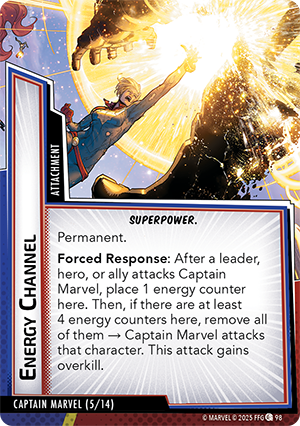
For example, the retaliate keyword is now defined as “Forced Response: After this character is attacked, deal X damage to the attacker.” Previously, if you were fighting the Captain Marvel leader and she had gained retaliate from another card, you would have to remember that keywords have timing priority over the Forced Response effect on her Energy Channel attachment. Now, you can compare their timing triggers, see that they have the same triggering condition, and so can choose the order in which to resolve them. Before, your ally would have to take retaliate damage from Captain Marvel before placing a counter on Energy Channel and potentially getting attacked. Now you have the choice to resolve Energy Channel first, potentially having Captain Marvel attack into your ally’s tough status card before the ally takes the retaliate damage.
Note that status cards still take priority over other Forced Interrupt effects. This is necessary to prevent problems from arising if a Forced Interrupt to a character attacking, scheming, or thwarting were to resolve before the status card cancels the attack, scheme, or thwart.
As a result of defining keywords in game text, a couple of keywords have changed slightly in their function:
Surge
The surge keyword now simply deals you a facedown encounter card. It no longer requires you to immediately reveal that card. This clears up some confusing timings around revealing multiple encounter cards and makes it easy to remember in what order to resolve encounter cards dealt to you because you simply put the encounter card dealt by surge at the end of your encounter card queue.
It also provides a slight buff to cards like Return the Favor (Sinister Motives, 15) that require you to reveal an encounter card during the player phase. If you happen to get a card that surges, you won’t have to deal with the second encounter card until the villain phase.
Just remember, the villain phase does not end until all players have resolved all facedown encounter cards dealt to them!
Overkill
The overkill keyword works slightly differently from before in that it no longer duplicates the excess damage dealt to the ally or minion. Instead, it transfers the excess damage to the identity or villain after the ally or minion is defeated, respectively. Because overkill damage now requires the initial target of the attack to be defeated, it should be easier to remember that no overkill damage is dealt if the attack’s damage is prevented (for example, with a tough status card).
This change simplifies the process of determining how much overkill damage to deal, as well as removes an unintuitive element of overkill attacks generating more damage than they say they do.
Most cards in the card pool will still function as you would expect under this change, but let’s walk through an example to demonstrate what has changed. Imagine you are engaged with a Dragon (Mojo Mania, 42) that has two hit points remaining. You decide to play Relentless Assault (Core Set, 53) to deal five damage to Dragon with overkill. Because Relentless Assault has an energy resource icon, damage Dragon takes from it is doubled to 10. That 10 damage is placed on the Dragon, defeating it with eight damage beyond its hit points. That eight damage is then dealt to the villain.
Note that all of these keyword definitions are written in such a way that the keyword on a card could be substituted for the definition with minimal rewording. That is why keywords like overkill that are granted to attacks are not written as triggered abilities.
As an example, you can think of an ability like:
“Hero Action (attack): Deal 5 damage to an enemy. This attack gains overkill.”
As being equivalent to:
“Hero Action (attack): Deal 5 damage to an enemy. If this attack defeats an ally, deal the damage beyond its hit points to the identity of that ally’s controller. If this attack defeats a minion, deal the damage beyond its hit points to the villain.”
Teaming Up
With this update, we are making official a rule that many of you in the community have already been using. We have revised the player deck construction rules in the following way: you can now replace an identity-specific ally in your deck that matches another player’s identity (under the uniqueness rules) with a team-up card for your two identities. This means that the two Black Panthers, T’Challa (Core Set, 40) and Shuri (Black Panther, 1), can replace their ally versions of the other with a copy of Heart of the Panther (Black Panther, 25). This encourages the use of team-up cards and thematic hero pairings in multiplayer games, while also eliminating the unpleasantness of having a card in your deck that you can’t play.
Quick Notes
The following updates are important enough to note, but don’t require in-depth explanation:
Attack (Enemy Activation): We have added a new step to the process of an enemy attack: calculate damage. This step provides us a timing point in which abilities that come after boost cards are resolved but before damage from the attack is dealt.
Initiating Abilities: We have moved the “place the card on the table” step to be the first step in the process. This way, everyone at the table can see what is being played and help determine if the card can be played at that time. We have also established the “check play restrictions” step (now second in the revised process) as the point at which form restrictions are checked.
Resolve: We have added a new entry defining the word “resolve.”
Reveal: We have clarified that responses to any part of the process for revealing an encounter card wait until all steps of that process are completed. This means that minions with quickstrike will not resolve that keyword until after they have finished being revealed (including resolving their “When Revealed” ability, if any).
Swap: We have slightly revised the rules around swapping cards by specifying that the swapped cards maintain the orientation of the original card. The biggest impact of this is on Deadpool’s card, Armed to the Teeth (Deadpool, 9), which can no longer “ready” a weapon when it swaps it out for a new one.
“That [Target]”: In order to simplify the rules around valid targets, we have removed a bullet from the Target entry that prevented an effect that refers to a target in a previous sentence (for example, “that minion” or “that scheme,” etc.) from targeting a card that was not a valid target for the previous sentence. For example, you can now use Concussive Blow (Psylocke, 14) to damage an enemy that you cannot confuse.
Limited Environment: We have heard your feedback that 10 hero packs to build your deck from when playing in a limited environment is not very limiting at all, so we have reduced the number of hero packs you may choose when creating your own limited environment to four. Along with the six heroes you get from your three chosen campaign expansions, that gives you a total of 10 preconstructed decks from which to build your own deck, some of which will be from aspects other than your chosen one.
Hercules’s Labors: We have added an FAQ about what happens to one of Hercules’s Labor cards if it is unable to find a valid target or if it somehow leaves play without going to the victory display. In these cases, the card is placed on the bottom of the Labor deck.
Errata
There are a few errata in this update worth mentioning. First, Wonder Man’s Ionic Physiology (Wonder Man, 2) has had its cost arrow changed to the word “then.” With this change, you are now able to tuck an event card under Ionic Physiology even if you are at your maximum hit points. This better aligns with the intent of the hero’s designer and how the card was tested. Note that you must still be able to tuck the event under Ionic Physiology to heal a damage from Wonder Man.
The Moon Knight minion (Synthezoid Smackdown, 65) has received a limit to his “When Revealed” ability to prevent an infinite loop with the Teenage Superheroes (Synthezoid Smackdown, 58) treachery. Moon Knight will still trigger Teenage Superheroes if it is the topmost treachery in the encounter discard pile, which will then trigger each “When Revealed” ability on each enemy in play, but because Moon Knight’s ability is now limited, it will not trigger again.
Finally, we have changed the limit on the Iron Man (Core Set, 29A) hero’s ability to read “(to a maximum of +6 hand size)”. This lets Iron Man benefit from cards like Assess the Situation (Civil War, 53), even if he has maxed out his hand size from Tech cards in play. This change allowed us to simplify the rules around ability maximums.
Those are the main changes we wanted to highlight in this update, but there may be others that may impact your understanding of the game. As always, if you have a rules question you just can’t figure out, you can send it to us through our rules contact form: https://www.fantasyflightgames.com/en/contact/rules/. Please note that answers provided through our contact form are preliminary and may be revised later. Those answers can be considered settled when they are codified in a future Rules Reference update.
Until next time, keep saving the world!
Tony Fanchi
No products found.
Related News
Way of the Iron Fist
Presenting a First Look at the Iron Fist Hero Pack for Marvel Champions: The Card Game
Killer Instinct
Presenting a First Look at the Elektra Hero Pack for Marvel Champions: The Card Game
Creeping Corruption
Presenting a First Look at the Shadowland Scenario Pack for Marvel Champions: The Card Game
